Thursday, May 30, 2013

Beginnings and Believability in Dystopias

Good Thursday,

Today’s post might be a bit of a rant. I love urban fantasies and dystopias. They are what I read and, mostly, what I’m interested in writing. This post is more about dystopias.

I read an interesting article a few days ago that talked about why some dystopias don’t “make it.” One point was that we (the reader) are thrust into this post-apocalyptic world where every freedom known by Americans has been suddenly and completely “forgotten.” The rich live the good life, and the pour live in the equivalent of work camps. And there is no explanation as to how the world got this way. The reader is expected to just accept it.

Over the long weekend, I picked up a couple of dystopias. For each, I read 3 or 5 chapters before putting them down and half-heartedly telling myself I’d go back to them. No such thing will probably happen.

Why? Partly because of what the previously mentioned article said—the believability was flawed. More, though, because of how the stories began.

A paradox—if you will. In studying the craft of writing, I’m told to “begin in the action.” In the same breath, I’m told to “show the character’s normal world before launching into the earth-shattering events.” There’s a problem here. Many characters’ “normal worlds” are not filled with tension and conflict. Yes, conflict comes in all types (see this post for specifics on the argument), but starting with an unrelated conflict for the sake of beginning with a bang just seems…unnecessary. As a reader, I personally want my first chapter to establish the world. It doesn’t bother me if we’re not jumping off of buildings or fighting fire-breathing dragons in chapter 1. I want to get to know my character and my world, especially if it’s a fantasy or sf story.

The two books I put down over the weekend jumped into conflict. The first started with the main character in the back of a truck with a bunch of other girls. Very quickly, the girls were out of the truck and either being killed or sold. The main character was sold (because having her killed would have made for a really short story) and taken to a house where the story unraveled all-too-quickly. I felt like I was drowning in the speed of events.

What really made it a tough sell, though, was the massive amount of flashback-type scenes. There is a time and a place for flashbacks. They are usually used sparingly and show events long before the story in order to help see critical points in the character’s life. These flashbacks showed events that happened, as far as I could tell, almost right before chapter 1 started. Why didn’t the author just write the flashbacks as chapter 1 (thereby showing her main character living in poor conditions and being kidnapped)? Instead, I was tossed into a situation with no idea how I’d gotten there and forced to watch, what would have been awesome scenes, flit by as afterthoughts.

It’s a shame because the concept behind the book was good. But the choices and pacing just lost me.

The second book—I don’t know what to say. It began with a conflict that ended very quickly—too quickly. The chapters were twice the length of a normal chapter. While there isn’t a set-in-stone page count for chapters, 3000-4000 words is a good range to aim for. Too much more and the book just drags.

There was no real explanation of how the world got to its current state. The reasoning behind the battles to the death, though, was established. It was a bit overdone—“we are weeding out the weak in order to build a powerful army”—but at least it was there. My problems really started in chapter 2. Characters, organizations, and plot twists started flying and didn’t stop. By the time I gave up the character had joined a secret society, been told she needed to kill her “clone,” watched her family die, told her brother’s best friend/her best friend/I’m not even sure to get lost, and murdered a teenage girl without any feelings of regret. That was a lot to swallow in such a short time, and I just couldn’t do it.

Things to take away from this:

-When they say “start with action,” they don’t mean “skip any form of introduction and launch straight into the earth-shattering moment.” If we don’t see “normal life,” we can’t judge how life has changed.

-Balance the beginning chapters. Introducing too little causes stagnation and loses readers. Introducing too much causes confusion and loses readers. It’s said of the entire manuscript “if it’s not necessary to the story, odds are good it doesn’t need to be in there.” That applies to the opening chapters as much as the rest of the book. And just because it doesn’t belong in the opening chapters doesn’t mean it doesn’t belong in the story. Chapter 2 just might not be the right place to casually let it slip that your main character is an alien and part fairy…and an assassin…and has DID (dissociative identity disorder)…and has a drug problem…and—you get the idea.

Monday, May 27, 2013

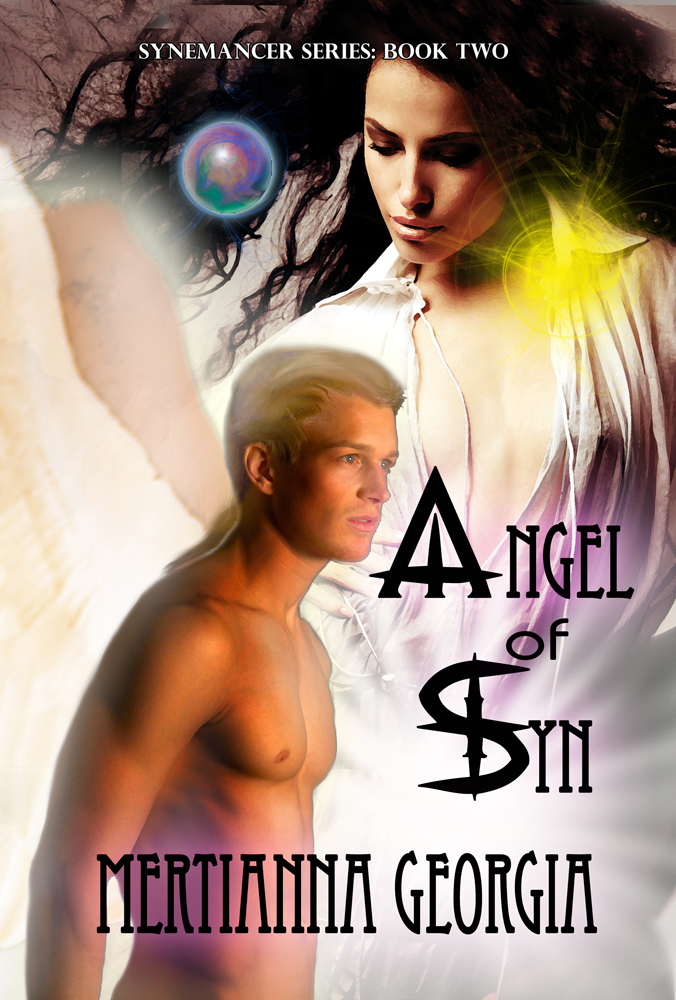
Book Tour--ANGEL OF SYN

Goddess Fish Book Tour

ANGEL OF SYN by Mertianna Georgia
A paranormal urban fantasy

AN INTERVIEW WITH MERTIANNA
-What book and/or experience made you want to be a writer?

So many! The more recent fantasy writers like Laurell Hamilton, Anne Rice, Jim Butcher, Charlaine Harris, Kim Harrison, and others. But also the writers I grew up reading…Orson Scott Card, Frank Herbert, Ray Bradbury, Arthur C Clarke, Ursula Le Guin, Tanith Lee, Anne McCaffrey, Robert Heinlein, and the list goes on. They have all inspired me to one degree or another.

Because my father was in the military, our family moved every couple of years. The base libraries became my favorite place to be and reading my favorite thing to do. I especially liked reading about animals, SciFi and Fantasy. Those books helped me expand my horizons and develop a life-long desire to create worlds of my own through writing. I still get excited when I see one of those books, knowing the emotions they can still elicit in me – from wide-eyed wonder to pull-the-covers-over-your-head shivers.

-What genre(s) do you write?

I write Urban/Paranormal Fantasy, Mystery, and Literary Fiction. I may wander into other genres, but not at the moment.

-Book title and blurb.

ANGEL OF SYN. Book Two in the Synemancer Series.

Contemporary witch Cara Augustine goes international and inter-dimensional, from San Francisco to France to an alternate Eden-like dimension, in this second book of the Synemancer series.

Cara is a fugitive, pursued by the Portalkind police for breaking a major covenant. When she accidently made a werewolf her witch’s familiar, it amounted to enslaving a human. And the punishment is death. On the run for her life, she and her companions stumble into a strange paradise dimension. But they quickly find the dangerous world is filled with strange creatures, deadly and beautiful. And, because she’s quickly learning a Synemancer’s life is never simple. Cara has to deal with an amorous Nephilim (half-angel half-witch), a dangerously deranged French werewolf, and the darkly handsome Nightkind she just might love. Each powerful supernatural man has his own reasons for wanting to possess Cara, body and soul. But if the Portalkind police catch her, she’ll be in a fight for her life.

-Spoilers?

“Bart straightened from his defensive semi-crouch, still eyeing the Hounds warily. I glanced around the room to see if the orbs were here, but they were nowhere in sight. The mirror chimed and shimmered for the umpteenth time since I’d come into the room. A tall, pale man dressed in black and wearing a black backpack walked into the room. Azrael stood silently on Amelia’s hardwood floor, and by the expression on his beautiful face, he was angry enough to chew spells and spit out hexes. He quickly scanned the room. His ice-blue eyes focused on me and I had his full attention. All Hades was about to break loose. With two weres, two Hellhounds, and a Nightkind in the room, the situation was about to get bloody.”

-For aspiring writers, any tips?

Keep writing, finish your stories, never give up, and learn as much about the craft of writing as you can. Watch a little less t.v. or spend a little less time on the internet and use that time to write. Now if I can just take my own advice, I’d get a lot more done.

-What’s your favorite book/genre to read?

It’s been changing, but I love to read urban fantasy and YA paranormal. I also like mysteries if they have a good dose of humor thrown into the mix or a few ghosts or maybe a grim reaper.

-What’s your favorite thing you’ve ever written?

My favorite story is called The Cat Maiden, a paranormal twist on an Aesop’s fable. It’s my favorite because not only was it the first short story I had published, but my son liked it too. That was important to me.

ABOUT MERTIANNA

Mertianna currently lives with her husband, son, and three dogs in Northern California. At a young age, while traveling the globe with her military family, she discovered the joys of reading. Armed with a fascination for science fiction, the paranormal, and fantasy, she amused, shocked, and impressed her teachers with her imaginative stories.

“I currently live with my husband and dogs in northern California. I have a son who attends college in San Francisco. After years of working in the business world while secretly wishing I could be a writer, I finally took a leap of faith, stopped working (in business) and started writing. My first book, SYN IN THE CITY, was published in 2010 and I haven’t looked back since.”

As an adult, reality reared its boring head, and she joined the business workforce. After many years working as a professional manager while secretly wishing she was a writer, she took a detour from the corporate world to immerse herself in the fictional worlds of her own making.

Mertianna has accumulated multiple graduate degrees in business and survived years of doctoral studies in psychology, all of which undoubtedly has influenced how her characters behave or don’t behave as the case may be.

“I have a website at mertianna.com. My blog is on the website. I hope to get my author Facebook page up soon (which should have been done long ago). Unfortunately I have a huge streak of procrastination in my nature. I think I may have a new pair of pants to hem sitting in my closet from 2010.”

Buy ANGEL OF SYN on amazon in print or ebook form. The book is also available on ImaJinn Books website.

---
Hey readers,

I know I’ve said this before, but I’m an urban fantasy junky. Thanks for an awesome interview and amazing-looking read, Mertianna!

Interested in ANGEL OF SYN? Follow the tour here.

And don’t forget to comment often for a chance at a really cool prize.

Mertianna will be awarding a canvas tote bag printed with the book cover on one side and a saying on the other("Are you a syn-er?"), and filled with goodies plus a $20 Amazon gift card to a randomly drawn commenter during the tour (US ONLY).

Friday, May 24, 2013

Guest Post--Fleshing Out Your Villains

Hello folks,

I have a guest post from an author buddy of mine today, Lee Allen Howard. He’s here talking about his new release, DEATH PERCEPTION, and the process of making a great villain.

Fleshing Out Your Villains

As readers, we’ve come to expect the fully developed protagonist. After all, if the main character is a pasteboard creature, who wants to read the story? So writers spend a lot of time developing their protagonists, and, perhaps, their “helper” characters.

But one thing I’ve learned to do is to give my antagonist equal treatment. Early in my writing career, I created antagonists—what I called “villains”—for the sole purpose of frustrating my hero and his goals. This led to “cardboard villain syndrome.”

Your protagonist and plot are only as strong as your antagonist. He or she (or it or they) must also have a backstory that has led to the development of certain weaknesses, strengths, fears, desires, and goals. He might be an evil bastard, hell-bent on destroying your protagonist, but he also might be a decent guy who just wants the same thing your hero/ine wants, and has the gumption to compete for it. Or he wants the exact opposite of what your hero/ine is striving for, and is willing to fight for it.

Your villain cannot be a skeleton (unless we’re talking about that story I wrote in second grade). He/she/it/they must be fully fleshed using the same development tools you used for your protagonist.

The best information I’ve encountered in 20 years of reading and writing fiction—and reading about writing fiction—I discovered recently in Robert J. Ray’s The Weekend Novelist, in the sections “Weekend 1” and “Weekend 2.” (If you buy this book, be sure to get the original 1994 version, not the revised version.)

Ray leads you through the process of writing a brief character sketch (the broad strokes), plotting a timeline for life and story events, developing a backstory by asking “what if?” to probe motivation, and building a wants list—for your protagonist, your helper, and your antagonist, exploring where desires mesh and clash.

I followed such a process in DEATH PERCEPTION, my latest supernatural thriller tinged with horror and peppered with dark humor.

By devoting as much effort to your antagonist as you do to your protagonist, you will have a stronger story, one that readers will love. Flesh out your villains, and you’ll flesh out your fiction.

DEATH PERCEPTION is available in trade paperback, Kindle (.mobi) and Nook (.epub) at leeallenhoward.com.

ABOUT LEE

Lee Allen Howard writes horror, dark fantasy, and supernatural crime. He’s been a professional writer and editor of both fiction and nonfiction since 1985. His publications include The Sixth Seed, Desperate Spirits, Night Monsters, “Mama Said,” “Stray,” and DEATH PERCEPTION, available in various formats at leeallenhoward.com.

MORE FROM LEE
You can keep in touch with Lee on his Facebook author page. Follow him on Twitter @LeeAllenHoward.

Wednesday, May 22, 2013

Book Tour--THE CRACKED SLIPPER

Goddess Fish Book Tour

THE CRACKED SLIPPER by Stephanie Alexander
A romantic women’s fiction fantasy

BLURB
When Eleanor Brice unexpectedly wins the heart of Gregory Desmarais, Crown Prince of Cartheigh, she's sure she's found her happily-ever-after. Unfortunately, Prince Charming has a loose grip on his temper, a looser grip on his marriage vows, and a tight grip on the bottle.

Eight years of mistreatment, isolation and clandestine book learning hardly prepare Eleanor for life at Eclatant Palace, where women are seen, not heard. According to Eleanor's eavesdropping parrot, no one at court appreciates her unladylike tendency to voice her opinion. To make matter worse, her royal fiancé spends his last night of bachelorhood on a drunken whoring spree. Before the ink dries on her marriage proclamation Eleanor realizes that she loves her husband's best friend, former soldier Dorian Finley.

Eleanor can't resist Dorian's honesty, or his unusual admiration for her intelligence, and soon both are caught in a dangerous obsession. She drowns her confusion in charitable endeavors, but the people's love can't protect her from her feelings. When a magical crime endangers the bond between unicorns, dragons, and the royal family, a falsely accused Eleanor must clear her own name to save her life. The road toward vindication will force a choice between hard-won security and an impossible love.

The Cracked Slipper is a book club friendly fairytale retelling in the vein of Gregory Maguire, with a dash of romance. Set in a pseudo-renaissance, corset-and-petticoats enchanted kingdom, The Cracked Slipper brings a magical twist to women's fiction.

EXCERPT
The dragon stood and lumbered toward the first cave. It passed the other unicorns, slowing every few steps, and they responded with reassuring whinnies. The next dragon appeared, followed by two more of Tremor’s unicorn guides. The first dragon called to the second, who screamed once in return. Both creatures seemed eager to get underground.

The transfer continued for nearly an hour without much fanfare. Eleanor thought she must have miscounted when there was a break in the procession.

“This will be the last one,” said Gregory. “I wonder what’s taking so long.”

Tremor paced at the mouth of the cave. Dark smoke rolled from under the ground. Tremor sent two of his fellows down below, and when after a few minutes they did not return, Thromba called to him to send two more.

Without warning, and with an earsplitting scream, and a new dragon burst from the cave. Stubby horns revealed her as a doe.

“Ho!” Gregory yelled. “Nestlings!”

Three baby dragons, about the size of saddle horses, squealed and circled their mother’s feet. She screamed and shot fire at the wall of men and unicorns. The men fell back. The unicorns just shut their eyes. As Gregory steered Eleanor toward the cabin she caught a flash of white behind the dragon’s legs. Teardrop had somehow been pushed from the line. She was pinned between the raging dragon and the canyon walls. As the dragon backed and reared, her massive tail, all wrathful muscle, swung in a deadly pendulum.

“Teardrop!” Eleanor screamed.

Teardrop zigged, looking for a way around the mother dragon. The dragon’s tail came down hard and clipped the mare across the shoulder. Teardrop slammed into the rock wall. She cowered, stunned and heaving.

“Teardrop!” Eleanor yanked free of Gregory’s grip.

“Eleanor, stop!”

She ran past the startled guards and into the chaos.

“Get back!” Tremor snorted.

“I won’t!” She yelled to be heard over the dragon. “I’m going to help her.” “You can’t, and we must control this situation.”

“I will, damnit!” She tried to get around the stallion but he stepped in front of her again. “Get out of my way!” she stormed.

He lowered his head. “If you insist on this foolery at least let me help you.”

Gregory was shoving past the guards, but she climbed onto Tremor’s back before he could reach her.

“Eleanor!” Gregory screamed.

She clung to Tremor’s mane as he raced at the dragon. Her eyelashes stuck together in the blinding heat. Tremor dodged and wheeled as the dragon spit fire. Two other unicorns flanked them.

Tremor skidded to a stop. Eleanor leapt off and ran to Teardrop. “Hurry!” Tremor called.

Foam dripped from Teardrop’s muzzle as she pressed against the wall. She wasn’t bleeding—her thick hide was nearly impenetrable—but a raised welt marred her shoulder. Her eyes rolled.

“Teardrop,” Eleanor tried to keep her voice calm over the screams of the dragon as it went after Tremor. “Help me. Take me back to Gregory.”

Teardrop swung her head at Eleanor’s voice. Her dark eyes came into focus. “Why are you here?” she whispered. “You will be killed.”

“So you must take me out.”

Teardrop nodded, and Eleanor grabbed her mane and pulled herself onto the mare’s back. “Go, now,” she called. “I need you to get me past this dragon.”

Teardrop scraped at the ground with one hoof and pricked her ears. She watched Tremor and his helpers and the mother dragon. She spotted an opening and dove for it. The dragon spun and swung her tail again. Eleanor held on as Teardrop leapt. They barely cleared the spinning spikes.

They came to a stop past the line of unicorns, and Eleanor’s legs gave out when she slid to the ground. Gregory caught her, cursing and kissing her.

“Dammit, Eleanor,” he said. “You’re the most stubborn, disobedient, brave, exasperating woman.”

She sat on the ground with her head between her knees. The magicians bustled around Teardrop. They tried to examine her injury, but she snorted them away. She stood over Eleanor, breathing down the back of her neck.

Eleanor raised her head as Tremor called a dozen of his fellows into the skirmish. The doe blew fire, but more unicorns pressed in and she backed down. Her children squeaked and smoked around her. Tremor stepped from the line and knelt on one knee. To Eleanor’s amazement one of the nestlings crept out from under its mother’s belly and slunk toward him. The doe hissed a warning. Tremor stood, and gently touched the baby dragon with his horn.

The doe exhaled a long blast of fire, but this time there was no fight in it. The other baby dragons came forward, and Tremor touched them all before nudging them toward the new cave with his muzzle. Their mother let our several low whistles and followed them.

Once the doe disappeared under the ground, Thromba ran to Eleanor and Gregory. “Dear HighGod, sire,” he said. “It was a botch-up, and the princess nearly roasted.”

“No, Thromba,” Gregory said. “We both know you can never tell how the does with nestlings will react. Last year we lost three men to a new mother. Not so bad, really.” He knelt beside Eleanor.

“Are you angry with me?” she asked.

“No,” he said. “How can I be angry? But you must be more careful.”

He helped her stand on her shaky legs. She ran a hand over Teardrop’s withers and the white hide twitched under her fingers. “Does it hurt?” she asked.

“Some, but we heal quickly.”

“Princess,” said an airy voice behind her. It was Tremor.

“Thank you,” she said. “I’m sorry if I made things more complicated.”

Tremor lowered his head. “I thank you,” he said. “For reminding me of what is important.”

ABOUT STEPHANIE
Stephanie Alexander grew up in the suburbs of Washington, DC, the oldest of three children. Drawing, writing stories, and harassing her parents for a pony consumed much of her childhood. After graduating from high school in 1995 she earned a Bachelor of Arts in Communications from the College of Charleston, South Carolina. She returned to Washington, DC, where she followed a long-time fascination with sociopolitical structures and women’s issues to a Master of Arts in Sociology from the American University. She spent several years as a Policy Associate at the International Center for Research on Women, a think-tank focused on women’s health and economic advancement.

Stephanie embraced full-time motherhood after the birth of the first of her three children in 2003. After six wonderful years buried in diapers and picture books she returned to her childhood passion and wrote her own fairytale. Her family put down permanent southern roots in Charleston in 2011. Stephanie is an adjunct professor of Sociology at the College of Charleston.

Check out Stephanie’s website. Connect with her on Facebook, and follow her on Twitter @crackedslipper. Find The Cracked Slipper on amazon.

---
Hey readers,

Love me a good fairytale retelling.

Want more from this tour? Follow it here.

And don’t forget to comment for a chance at a prize.

Stephanie will be awarding a $10 Amazon gift card to a randomly drawn commenter during the tour.

Tuesday, May 21, 2013

Arguing for Writers

Good Tuesday,

I was very, very, very, very (you get the idea) behind on life last week. I only posted once. *horrified face*

I’m back on track this week. I’ll post three times, and to make up for my earlier blunder, I have a real writing-related post today.

There’s been talk within my circle of writers lately about writing conflict. As any good writer knows, conflict isn’t just fist/sword/gun fights. There’s internal conflict, small group conflict, non-physical conflict, etc.

A big part of conflict is arguing. Being who I am, I am no stranger to the finer nuances of the well-orchestrated argument. I frequently forget that not everyone is familiar with arguing, though. As a writer, it’s important for the toolbox (or lockbox) to be filled to overflowing with every tool (lock?) imaginable.

So I’m here today to discuss the finer nuances of arguing.

***NOTE: No people were harmed or yelled at in the writing of this blog post.***

The Argument

Ever wanted to punch someone in the face? Yes? We’re going to get along wonderfully (just kidding). Maybe? You’re getting there. No? We’ve got work to do. As I said above, conflict isn’t always throwing punches. Arguments are often shouting matches with no punches.

Then why did I ask you about punching someone’s face? Arguments are the steps before the punches start flying. Once the first hit makes contact, the situation’s escalated past argument to brawl. I’m here today to talk about the crucial time before the broken noses and split lips.

How do arguments start? Let’s stick to two-person arguments for the sake of confusion. So person A disagrees with person B (or vice versa if you’d prefer).

A - “I want the green curtains.”
B – “I want the blue curtains.”

Seem stupid? Stay with me. You’d be amazed how many arguments blossom from simple statements like this. A and B have stated their different preferences. Now what? In a perfect world, one would say “you’re right. Let’s get the blue/green curtains.” This is not a perfect world, and so often, the things we say are not what’s really bothering us.

A – “I really want the green curtains.”
B – “And of course because you want them, we have to get them.”

Now we’re getting somewhere. The argument has taken a subtle shift. It’s no longer simply about the color of the curtains. B feels as if his/her needs are tossed aside in favor of A’s on a regular basis. B’s statement implies that A has gotten his/her way before—frequently—and used whatever methods necessary—begging, coercing, flat-out stating the “law”—to get it.

A – “What is that supposed to mean?”
B – “Please. It’s always what you want. Remember the kitchen floor tiles?”

More problems. A either doesn’t know or doesn’t want to acknowledge what he/she is like. But B isn’t being completely honest either. He/she is hiding behind curtains and floor tile choices to keep from stating the real problem.

A – “What does the floor tiles have to do with the curtains?”
B – “Of course you don’t know. Why would you know?”

Oh boy. If you’re anything like me, at this point you’re thinking “B, just say it.” But B doesn’t. In fact, once this pattern has begun, B will evade and lie until either the argument blows up (with no resolution) or until he/she is backed into a corner and has to say why he/she is upset.

A – “I don’t understand you!”
B – “You never have!” *storms out of the room*

Alternatively

A – “I don’t understand you!”
B – “That’s because you never listen to me. I’m not happy, A. Can’t you see that?”

The second option is the healthier one. Unfortunately, the first option is the one more often seen. In terms of fiction, you want to employ various versions of the first one until the end of the story. The first one widens the gap between characters through a lack of resolution. It’s tough to resolve anything when one person leaves. By contrast, option two shows a step toward resolution. “I’m not happy, A,” is a confession. B has finally said what’s bothering him/her. Now the discussing (rather than the arguing) can begin.

So there are the various parts of the argument. What are A and B feeling throughout this process. This is the part, I think, where most people get stuck. Anyone can write dialogue between two characters who can’t decide on curtains. It’s another thing to know and recognize the stages of an argument.

Blue vs. green curtains – Most likely, B’s emotions have been growing for a while. Arguments never come out of the blue (no pun intended). There’s always a backstory to every blow-out. Find a reason for your character to feel as if his/her needs are not being met. Be creative. Then when A makes the harmless “I want the green curtains” statement, B’s patience hit the last straw, and the claws come out. B is fed-up, hurt, scared, and wants, more than anything, to be heard. A, by contrast, is confused and can’t understand why his/her normally quiet partner is acting like this.

Of course you don’t understand – This is a classic line. It never gets old because it’s always used. B is trying to hurt A. He/she is trying to pull a confession out of A. They want to hear “you’re right. I don’t understand. What’s the matter?” This, unfortunately, is rarely the response they get. And sometimes, even when it is, B doesn’t respond by calming down and explaining. When people are riled up, sometimes they just want to fight. Yes, they want to resolve, but B’s desire to make A feel the same way B has for so long takes over. It’s no longer about fixing things. It’s now about causing pain.

You never understand me *door slams* - Ouch. B has thrown his/her last verbal punch and left A to either wonder or go back to what he/she was doing and not care. (That’s up to the author.) B, at this point, most likely gets in his/her car and drives to a friend’s house or until the car runs out of gas. He/she wants space. He/she wants to swear at the top of their lungs. He/she wants to play out the myriad of ways the argument could have gone and obsess on the reasons it didn’t go those ways. It’s not a pretty picture.

What’s going on with A during this time? If A is the “go back to what he/she was doing and forget it” type, A is watching TV, going out with friends, or getting ready to move out—“I don’t want to put up with this anymore, so I won’t.” If A is the wondering type, A is as emotionally distraught as B. A is going to sit in the silent house and think about what could have caused the argument. If A is really caring, A will wait for B to return and try to resolve the earlier blow-out immediately.

B – I’m not happy because your mother did it again.”
A – “My mother has nothing to do with this.”
B – “Yes, she does. Why does she hate me?”
A – “My mother hates no one. Get over yourself.”

This is a very bad direction for an argument to take. Either A is right—his/her mother hates no one—and B is overly emotional, or B is right—A’s mother hates him/her—and A is being irrational.

If A is right, this could be a relationship ender. Attacking family members without good cause rarely ends well. A is feeling betrayed—how could B be so mean? B is frustrated—how can A not see what’s right in front of him/her.

If B is right, this is a good place for a meaningful speech on B’s part. You know, that speech that ultimately forces A to see the truth. At this point, A may or may not be aware that he/she is rapidly losing ground. If A is not aware, he/she will keep the argument going—why stop now? If A is aware, there’s one of two options. Either A will relinquish the anger and actually talk to B, or A will make his/her argument louder and more forceful to hide that he/she knows he/she has lost. It’s called denial, and people love it when they might be wrong. “No way am I admitting the other person is right.” Except that’s about as healthy as storming out of the room.

And don’t forget the underlying emotions. While A is shouting all the louder to keep from sounding wrong, he might be feeling guilty but unable to admit it. Or he might not care. If B is winning, B might be feeling triumphant. Or B might be feeling bad for yelling, or, in a worst-case situation, B might be gearing up to say “forget it. I’m sorry I snapped.” That would only bring the argument back to square one.

The key with the argument is to know your characters. Who are they? Which role would they play in an argument? Do they fight for their stance or give in at the first sign of bad weather? How quickly to they give in? Do they have an ego problem that keeps them from being the first to give in/apologize? You need to know all of these and more, depending on the specific argument.

I hope I’ve given the baffled arguer somewhere to start. If you’re a non-confrontational person, understanding the argument can be tough. It took me a while to stop having my characters argue at every opportunity. Arguments were how I got through a lot of my childhood, but I’ve moved past them. I’m not saying to go out and argue for the sake of research, but staying calm all the time isn’t healthy either. Humans need to let out steam, and they need to stand up for themselves. Sometimes that means arguing.

Thanks for reading.

Wednesday, May 15, 2013

Book Tour--LUCID

Goddess Fish Book Tour

LUCID by Natalie Roers
A young adult paranormal fantasy

BLURB
Being hailed by critics as an intelligent new voice in young adult fiction, Roers' debut novel tells the anything but ordinary, coming of age story of a small town, teen aged, misfit named Travis Hunter.

Disfigured at birth and ostracized at school, Travis dreams of acceptance and secretly yearns for the affection of a beautiful young woman named Corrine. When a mysterious doctor promises to help Travis through something called lucid dreaming, Travis suddenly finds himself ushered into a secret society called "The Lucid", a collection of social outcasts like himself, who have created their own world inside of dreams.

When Travis discovers he is able to bring Corrine into these dreams, he gets more than he ever bargained for and soon finds himself learning the secrets of love and life in a fantastic unconscious world.

An instant classic, Lucid is a timeless story of self-acceptance with a fresh paranormal twist.

EXCERPT
Corrine sipped nervously at her coffee, looking for the most appropriate way to brush over the topic. “It was just nice being able to be ourselves, ya know? No fears, no consequences, no regrets. It’s such a significant word, isn’t it?”

“What word?”

“Lucid. It means to have a clear perception of things. Don’t you think it’s funny that it would take a dream for us to see clearly?”

Corrine placed her coffee on the ground next to her. “Like you,” she said. “Who would’ve known you were like this?”

“Like what?”

“Well for one, you talk!” She laughed. “I must’ve seen you dozens of times before. Why don’t you ever say anything to anyone?”

“I’ve been around enough people to know what they’re thinking when they stare at me. It doesn’t help me any to hear them say it.”

Corrine reached a hand forward and touched my knee. “I’m not gonna lie,” she said. “You do look a little different. You know what though? I don’t even notice it that much now that I’m talking to you.”

I looked down at her hand.

She pulled it back. “You should talk more,” she said, nodding. “Some people might surprise you. Not all of them…but some.”

---
"Roers' debut novel heralds the arrival of an intelligent, heartfelt voice in the world of young adult fiction. The rich characters, emotional complexity, and confident prose are matched only by the landscape of dreams that Roers sets them against... a landscape brought vividly to life by the author's seemingly boundless imagination. This is a novel that respects its readers as much as its characters, and that's a beautiful rarity." ~ Mike Flanagan, Filmmaker, Absentia and Oculus

ABOUT NATALIE

Natalie Roers is a veteran writer, voice artist, and on-air personality. A journalist by trade, Lucid is her first work of fiction. She is busy at work on her second novel and hopes to raise money and social awareness for worthy causes with each book she writes. Natalie plans to donate a portion of every sale of this book to her favorite anti-bullying organizations. She lives with her husband Cory, and son Austin, in Columbia, South Carolina.

Find Natalie on her websites: jointhelucid.com and Natasha-r.com. Connect with her on Facebook: Natalie Roers and Lucid. Check out her blog, and follow her on goodreads.

---
Hey readers,

I chose to host this tour, not only because LUCID looks like a great read, but also because I know how it feels to go through school different from the other kids. Having a disability does that to you. Well done, Natalie, for writing about the different kid.

Want more? Follow the tour here.

And don’t forget to comment for a chance at a prize.

Natalie will award a $10 Amazon or BN.com gift card to one randomly drawn commenter.

Wednesday, May 8, 2013

The Kindle and I

Wednesdays are my day lately.

Ladies and Gentlemen, Boys and Girls, readers of all ages, I have exciting news.

Well, it’s exciting for me, and if you’re blind, legally blind, or a person who likes listening to books, it’s exciting news for you too.

By listening, I don’t mean audio books. It’s not actors reading. I mean accessible tech. I mean a computerized voice reading.

Think I’m crazy for liking that sort of thing. I am not. Growing up legally blind, reading options were slim. When I was a kid, it was Braille (which I’ve only ever been mediocre at) or talking books, which were fun when I was little. As I got older, though, and reading became both a pastime and a route toward academic success, Braille was definitely too slow, and audio books were, likewise, not fast enough.

Halfway through college, I discovered Bookshare. I’ve mentioned this site before. It’s a great resource for visually impaired readers. Its only drawback is that, though its staff and volunteers work very hard (and I commend them for it), there are so many books in the world. Getting all of them onto the website is a daunting task. I love Bookshare. I’ll always keep my membership, but in the academic-heavy life I’ve chosen, access to books is a necessity, and up until now, if Bookshare didn’t have it, it was check the local library to scan it. If they didn’t have it, it was order it from Amazon in paperback to scan it. If Amazon didn’t have it—which was rare—it was scrounge. In other words, if Bookshare didn’t have it, it was a ton of work on my part, and with deadlines, a ton of time was not something I always had.

On a more personal note, it’s always been a bone of contention for me that sighted readers have access to books the day they came out. I always had to wait, even with Bookshare most of the time, anywhere from a few days to a few years to read a “new release.” Think of how easy it is to go to a bookstore or go online and get a book. Now think of how inconvenient it would be if you couldn’t. Some would say “Well, then I just won’t read.” As a life-long book lover and a writer, that’s not an option for me. I love to read.

And now, kids, I’m on the same page. Amazon Kindle finally went accessible.

Didn’t they have audio books before?
Some kindle books had text-to-speech capability, yes. But the way they did it, they needed audio permissions from the author. The new method puts the books out there as assistive technology. Thus, audio permission isn’t needed, and all books can, with the right software, be listened to.

I downloaded said software last week. I’ve only read a few books with it so far (end of the semester no time and such), but man, it’s like a dream come true. The world’s library is at my fingertips. For someone who’s never had that option, it’s amazing. I can finally read all the books my author buddies have published. Depressingly few are on Bookshare at this moment in time.

Interested in this?

PC users—download: kindle for PC with accessibility plugin

It works. There’s two voices to choose from—one male and one female. Are they the best, no, but they’re understandable, and they allow the visually impaired to read kindle books.

I’m told there is also a Mac version. I don’t own a Mac, however. If someone with a Mac would like to do some market research and report in the comments if it exists and/or works, how cool would you be? You might even get 5 bonus points. 

Stay tuned for my day’s creative inspiration.

---
Oh my, Amazon,

Many years I have waited
For a gift like this to appear
Why, do you know over getting books?
I’ve so many times shed a tear

Oh my, oh my
I’ll write you customer reviews
Tell you of your good deed in detail
With this great option now, dear, there is no way I can fail.
If you work as you should.
It will be all good.

Did it finally happen?
Is it actually here for good?
No more scrounging for books in a format that works
But a method that could
let me get what I need
If I buy books
So I’ll buy books.

I could use a kindle.
It’s at last proved its worth.
To read books on kindle
What I’ve waited for since…since birth.

And with all the books to download
By my tech I won’t be mired.
As long as I get what I need
I don’t mind the price being highered.

It’s like a fairytale come true
Book source on which I can rely
And that’s how we’ll begin,
The kindle and I.

Once I have a kindle
My whole life will change
Cuz once I have a kindle
From books I won’t be estranged.

No frantic searching for class reading
No scanning page by page
All the books at my fingertips
Think of what I’ll save on rage.

And this gift of the word right at my side
Finally at last it’ll be mine
When we are hand in hand
The kindle and I.

You’ll hear the computerized voice
And say “I have a question for you.
Isn’t a voice that’s so impassive? A b*tch to listen to?”

And I’ll smile and hit the pause key
And I’ll sit you down next to me
“It might sound that way to you,
But if you knew what before this I’d gone through.

Of course the voice doesn’t matter to me.”
”All right then,” you’ll reply.
Oh what a pair we’ll be,
The kindle and I.
Yes, what a pair we’ll be,
The kindle and—

Unlimited.
My future is unlimited.
And I’ve just had a vision almost like a prophesy.
I know. It sounds truly crazy.
And true, the vision’s hazy.
But I swear someday there’ll be
Knowledge of this, through the world
That all started…with me.

And I’ll sit there with my kindle
Feeling things I’ve never felt.
And though I’d never show it
I’d be so happy I could melt.

And so it will be for the rest of my life
I won’t want nothing else till I die

The ability to read
The books that I need
By my tech not stymied.

The kindle and I.

-Parody of “The Wizard and I” from WICKED the Musical